
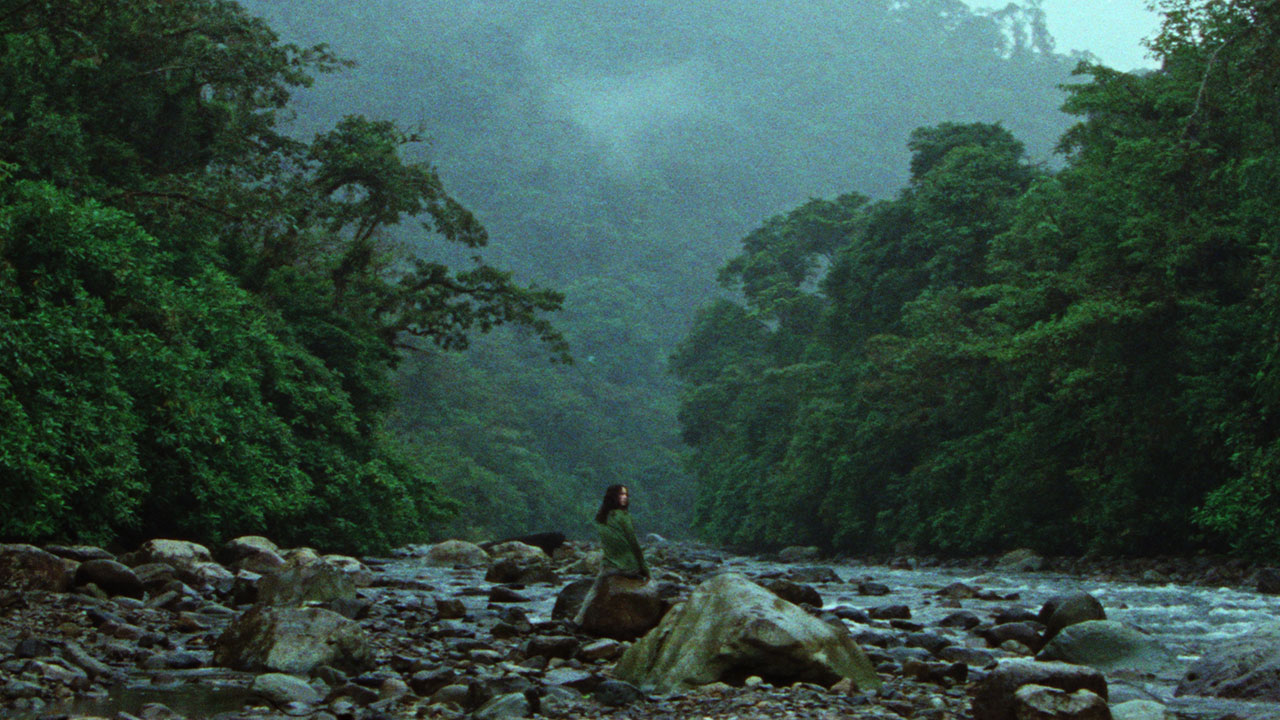
And Then I Knew ‘Twas Wind
Darius Mackenzie · 2026 · 88 minutes
Nov. 14 · Regal 1 · 1:45 p.m.
A writer goes missing on a canoe trip with her boyfriend in an area of Oregon known for its fossil record dating back sixty million years.
Programmer’s Note
“Well, should we get to the water?”
The first line of dialog comes nearly ten minutes into And Then I Knew ‘Twas the Wind, the debut feature by writer/director Darius Mackenzie. Maya (Miki Murray) and James (David Connelly) are a twenty-something couple making their way to the John Day Fossil Beds National Monument in central Oregon for a few days of canoeing and backpacking. Before hitting the water, they explore the visitor center, where they wander silently among paleontology dioramas and learn about the extinct animals that once roamed the area. Maya lingers over the fossil of a cicada, a living relic that has evolved little over tens of millions of years. James presses a button that fills the room—and the soundtrack—with prehistoric noise.
Mackenzie is showing his hand in the scene. The remainder of the film invites audiences to follow the couple’s lead: to explore a barren, alien, sun-bleached hillside in 21st-century America and imagine the rainforest that grew there tens of millions of years ago. “It feels like, at any moment, a portal might open up, and you could fall right through,” Maya tells James during a moonlight swim. It’s the kind of ominous, only-in-the-movies conversation that conjures magic. When James wakes up the next morning, Maya is gone and historical time has cracked wide open.
Taking its title from a line by Emily Dickinson—and also Toru Takemitsu’s chamber piece of the same name, which features prominently in the film—And Then I Knew ‘Twas Wind recalls L’avventura (1960), Michelangelo Antonioni’s modernist masterpiece about another young woman gone missing, and also the dream-like, lost-in-time films of Apitchatpong Weerasethakul. Shooting on 16mm in widescreen, mostly with natural light, cinematographer Chase Pottinger is a conjurer as well; the night scenes, in particular, are mesmerizing, singular, and otherworldly. Combined with Mackenzie’s droning soundscape, the overall effect is to create the sensation of infinitude. To quote the film’s epigraph, an entry from paleontologist Loye Miller’s 1899 journal: “Time is lost and years are but the pulse beat.”
Darius Mackenzie will introduce and discuss the film.
Darius Mackenzie has been writing and making experiments in film since graduating from the University of Wisconsin – Madison with a degree in Neurobiology in 2018. He has been working on his first feature film, And Then I Knew ‘Twas Wind, for the past five years. His work focuses on nature and mind and the endless enigmas of both.