
Act One
Sophia Takal · 2026 · 104 minutes
Nov. 14 · Regal 1 · 9:00 p.m.
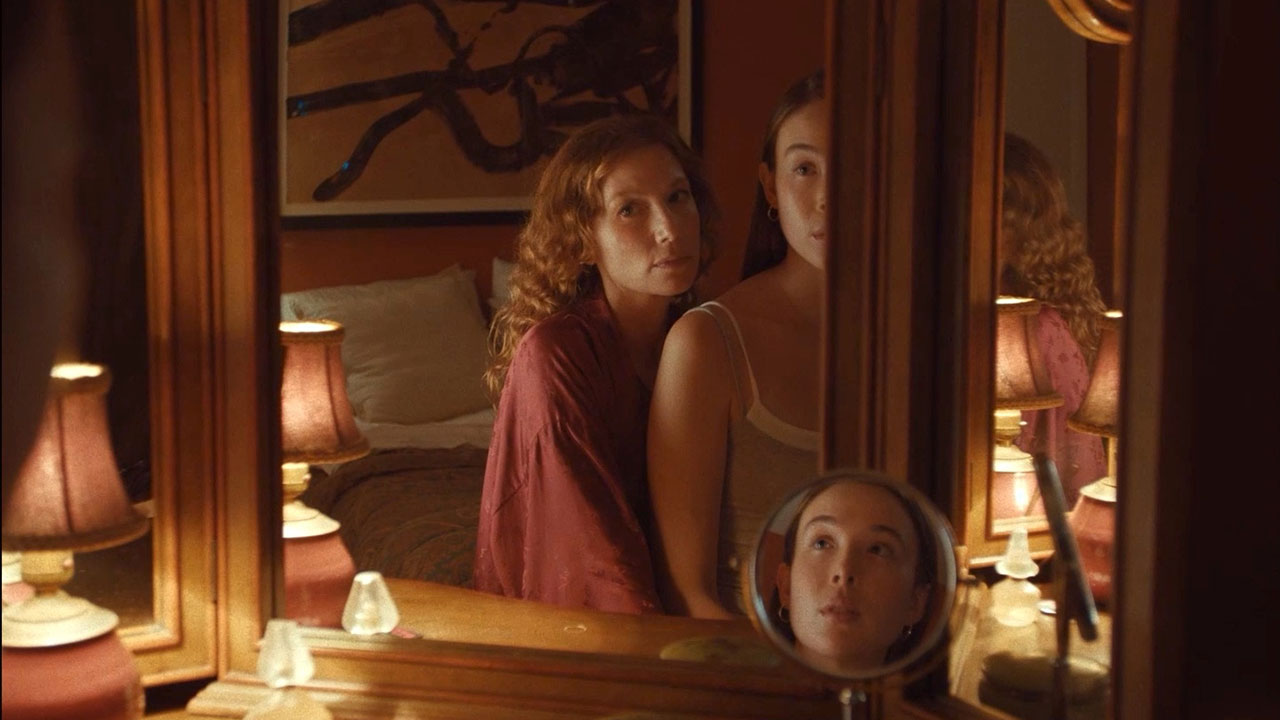
An aspiring young actress, desperate for guidance and belonging, falls under the spell of a manipulative acting coach who draws her into a web of control and obsession.
Programmer’s Note
Hannah (Ella Beatty) has photos of Bette Davis and Ingrid Bergman on her bedroom wall and Ibsen and Stella Adler stacked beside her bed. Her commitment to acting has, for better and worse, become her entire identity, alienating her both from her high school classmates and from her mother, who offers only criticism. When Hannah isn’t cast in her senior-year play, she goes looking for someone who takes her as seriously as she takes herself and soon finds Melanie (Ari Graynor), the magnetic founder of Act One Studios, who sees in her a “light” no one else has noticed. There are trust exercises, therapy-speak, and late-night rehearsals at Melanie’s house. There are too many red flags to count.
Writer/director Sophia Takal knows this world firsthand. As a teenager, she studied under an acting teacher who told her she could be an ingenue if she ditched her glasses. She got contacts, as does Hannah. When she started asking around, Takal found that her women friends and colleagues all had similar stories. Following Always Shine (2016), her study of professional jealousy between two actresses, and her remake of Black Christmas (2019) for Blumhouse, Takal returned home to the suburbs of New Jersey to make Act One on a shoestring. She shot in the same studio where she once took classes and leaned on high school friends, their parents, and a crew of PAs trained through Montclair Film. It’s a model of community-built filmmaking that should look familiar to anyone who’s spent time at Film Fest Knox.
Takal’s touchstones for Act One are the ’90s good-girl-gone-bad thrillers she watched as a teenager—Poison Ivy (Katt Shea, 1992), The Crush (Alan Shapiro, 1993), and Fear (James Foley, 1996)—reimagined through a female lens. Act One is certainly a cautionary tale about grooming, but Takal is after something thornier and rarer in contemporary American cinema: a young woman discovering her own ambition and desire, and learning her limits only after pushing past them. “I want audiences to walk away wondering, where was her own mind,” she told IndieWire. The film is perched, as Variety put it, between utter seriousness and high-wire camp, and Takal skillfully manages that tension—at times, unnervingly so. Beatty (the youngest child of Warren Beatty and Annette Bening) is a revelation, bringing an often uncomfortable nuance to Hannah’s coming of age, and Graynor finds a warmth and softness in Melanie that makes her a character so seductive we fall under her spell, too.
Sophia Takal and Stephanie Roush will introduce and discuss the film.

Sophia Takal directed the award-winning, critically-acclaimed film Always Shine, which premiered at the Tribeca Film Festival where it won the Best Actress Award for its star Mackenzie Davis. Takal’s debut film, Green, which she wrote, directed and starred in premiered at SXSW where Takal won the Emerging Female Director award. The film went on to receive numerous other awards and a Gotham Award nomination. Takal co-wrote and directed New Year, New You for Blumhouse/Hulu as well as Black Christmas for Blumhouse/Universal Studios. Repped by CAA and Untitled.

Stephanie Roush is a New York-based independent producer and founder of Foxglove Films. Her credits include Sundance Dramatic Competition selections Union County (Oscilloscope) and Stress Positions (NEON) and the Emmy-nominated documentary series Principles of Pleasure (Netflix). Her upcoming features include Stephen Cone’s System of Colors and Sophia Takal’s Act One, which premiered at the 2026 Tribeca Festival. She won a James Beard Media Award for her work with chef Vivian Howard, was a 2024 Gotham / Cannes Producers Network Fellow, and was named one of Variety’s “10 Producers to Watch” in 2026.